by Cissy Blanchard | Mar 8, 2025 | Financial Planning
Over the last several weeks, President Trump’s White House and the Department of Government Efficiency (DOGE) have taken sweeping actions across the public sector in an effort to reduce the budget deficit and save U.S. taxpayers’ dollars. Meanwhile, Trump’s ongoing push-me-pull-you tariff debate has disrupted domestic and international markets, creating uncertainty for U.S. consumers and businesses. We’ll explore a variety of economic data points and policy initiatives that outline why we believe the markets think these efforts have a lot of bark – and not much bite.
Post-Election Returns Since 1948
Historically, equity markets tend to rally after a presidential election. The S&P 500 has risen by 4.7% since the 2024 election, outperforming the historical average post-election return of 1.7% observed during the post-World War II era. While there are always other external factors impacting financial markets beyond just elections, market participants should take comfort in this historical pattern.
S&P 500 Returns 75 Days Post-Election Since 1948
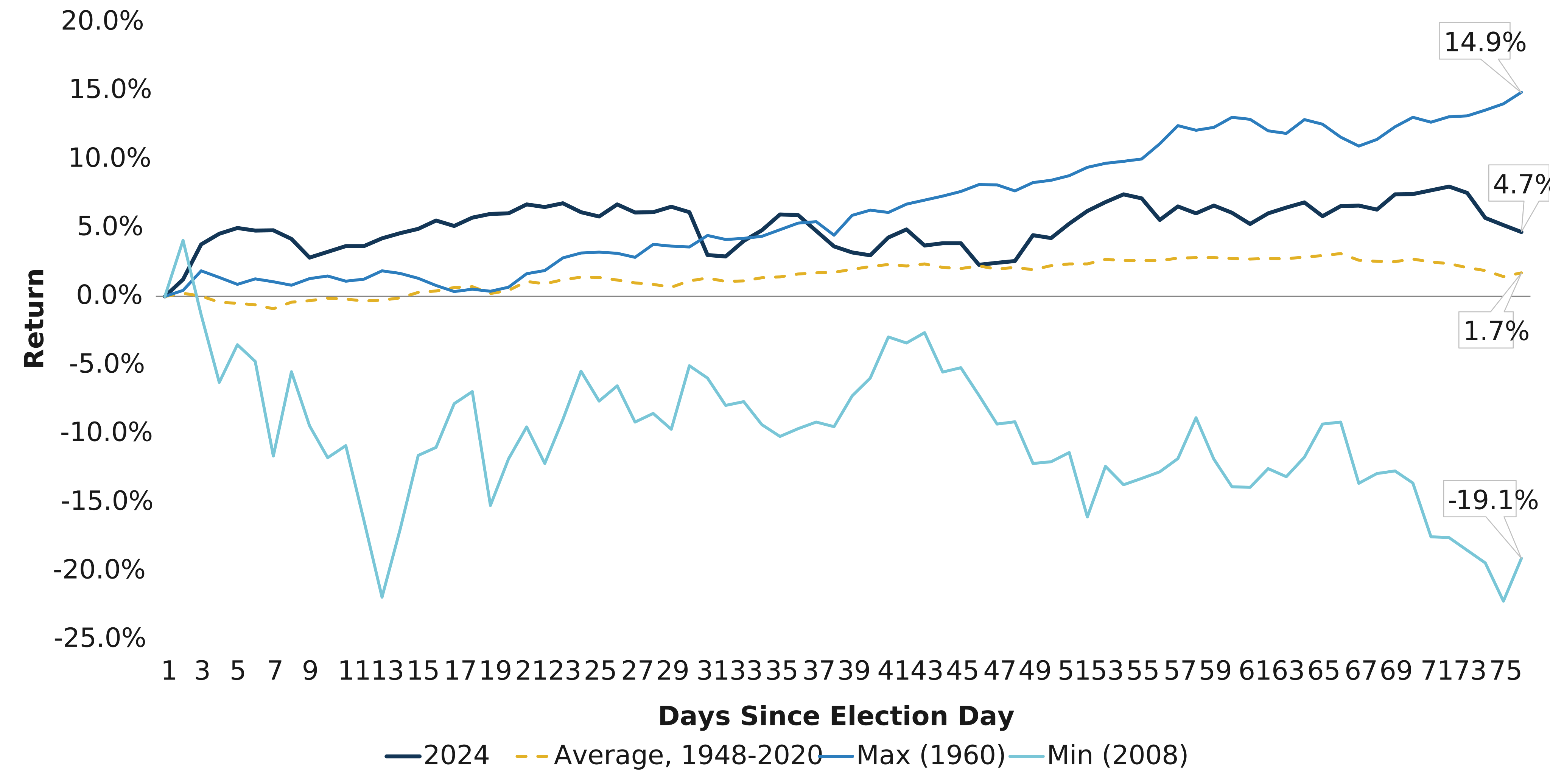
Source: Bloomberg, calculations by Horizon Investments, return is price return before the 1992 election and total return after, data as of market close on 02/25/2025. The S&P 500 or Standard & Poor’s 500 Index is a market-capitalization weighted index of the 500 largest U.S. publicly traded companies. Indices are unmanaged and do not have fees or expense charges, both of which would lower returns. It is not possible to invest directly in an unmanaged index.
Cross-Asset Returns in 2024 vs. 2016
Many have highlighted market moves after Trump’s election in 2016 as a potential reference point for price action. We cautioned here against leaning too heavily on this framework, given the different starting points for markets and the economy compared with 2016.
Asset Class Performance Post-Election Day
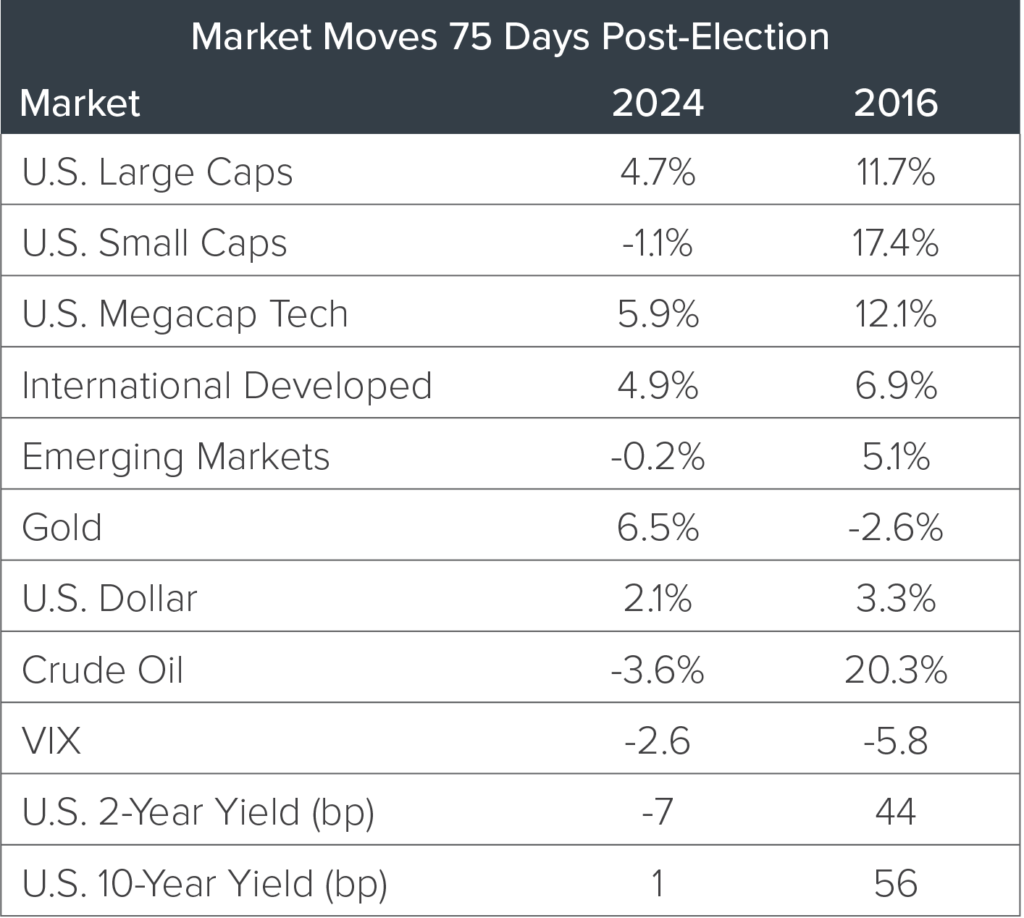
Source: Bloomberg, data as of market close on November 4, 2024 through market close on February 25, 2025, and market close November 7, 2016 through market close on February 28th, 2017. Please see attached disclosures for information about these market sectors. Indices are unmanaged and do not have fees or expense charges, both of which would lower returns. It is not possible to invest directly in an unmanaged index.
A quick glance at the above chart reveals more differences than similarities between the market moves in reaction to Trump’s first and second election victory. Equity markets have generally seen a smaller bump this time, which is consistent with more demanding starting valuations and less of a policy surprise. The decline in small-caps and the muted reaction in crude oil stand out to us, likely indicators that the market is concerned about the negative growth impulse of potential tariff policy and lower fiscal spending, more prominent features of Trump’s agenda today. Similarly, U.S. Treasury yields have also seen more muted behavior than after the 2016 election. The lower move in equity volatility is one commonality between both elections, which we highlighted in our pre-election piece and will expand on below.
Post-Election Volatility
Since World War II, equity markets have, on average, been less volatile during the first year of a new presidential term compared to all other periods. These results may seem surprising, but they are repeating this year. Despite the flurry of activity in Washington, equity volatility (so far) has remained below both the post-election year average and the overall yearly average.
Realized Volatility During the First Year After an Election Since 1948
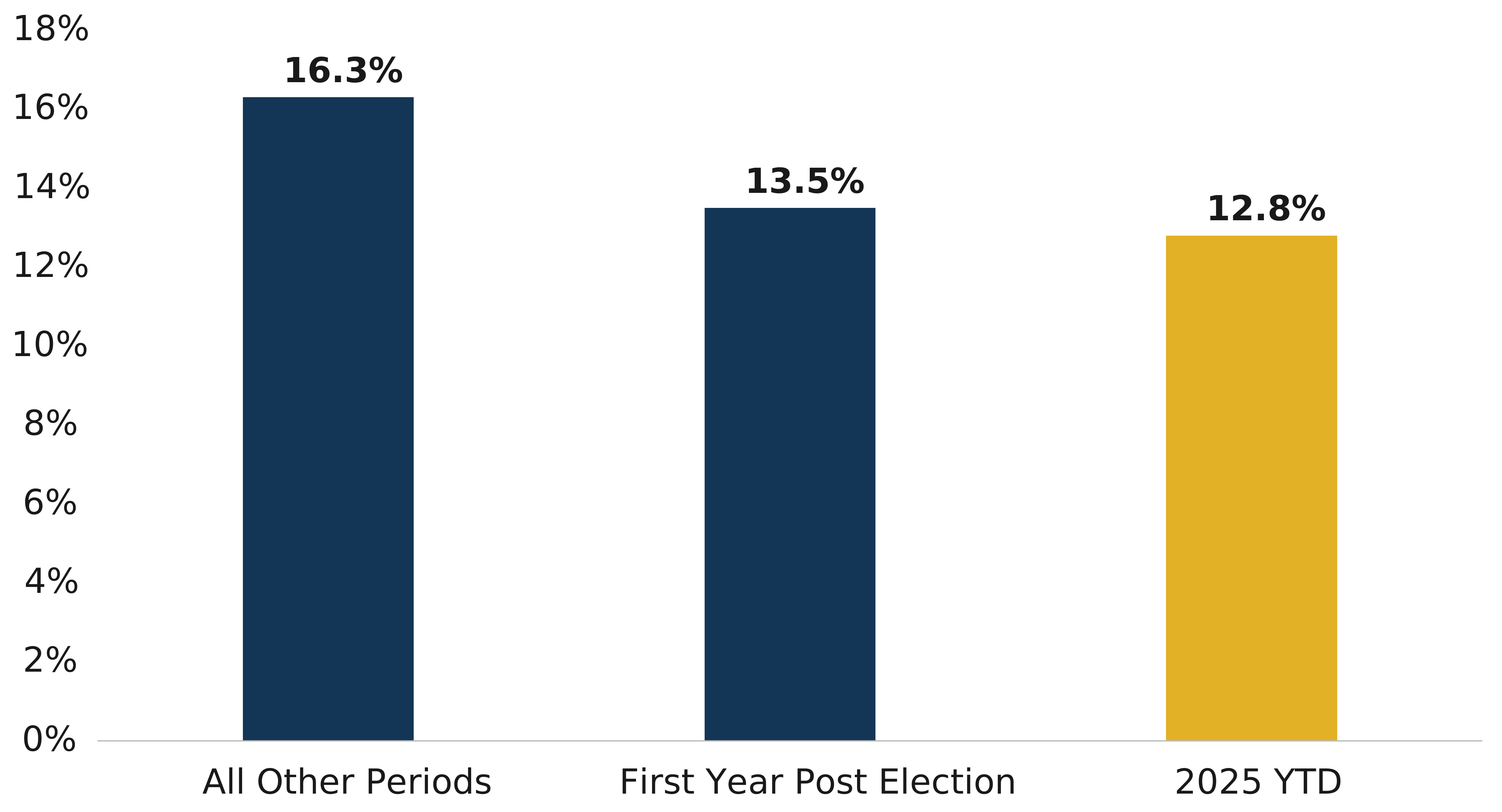
Source: Bloomberg, calculations by Horizon Investments, data as of market close on 02/25/2025.
Beyond easing fears after a major event like an election, there’s another special factor at play that’s helping to keep equity volatility low. Recently, individual stocks have been moving in divergent patterns – consider the difference between the AI-theme and the healthcare or banking sectors. This action tends to lower the volatility of the overall market. Environments like the current one may provide new opportunities as policies change and new trends emerge.
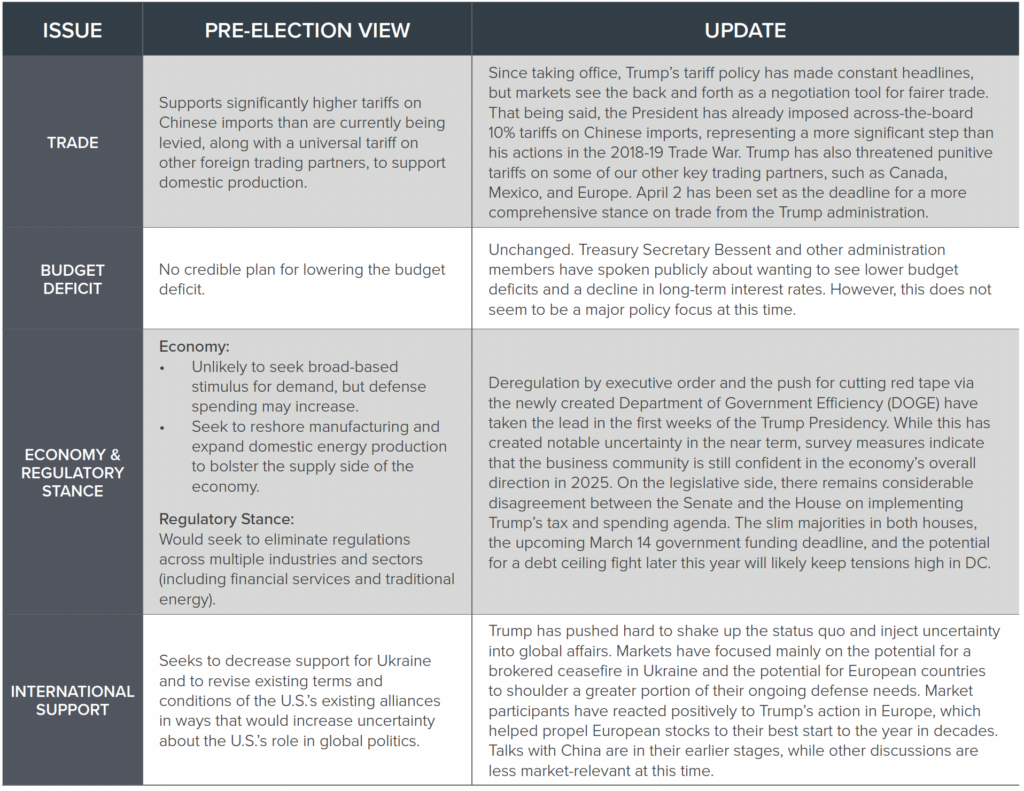
Update on President Trump’s Economic and Regulatory Initiatives
In our September pre-election piece, we highlighted several policy areas that we believed mattered to voters and markets. Below, we review five of these pre-election insights and compare them to what has happened since.
Conclusion
Today’s market landscape features a shifting balance between conflicting impulses: On the positive side, the rise in animal spirits in the business world and Trump’s deregulatory push support the economy and investor confidence. Against that, the potential business disruption of new trade policies and developments in the geopolitical arena creates unhelpful uncertainty. We expect this back and forth to uncover potential investment opportunities in the months ahead.
Taking a broader view, two points stand out to us from reviewing the above data, as well as the market price action and newsflow of the past months:
- Don’t freak out: Uncertainty and change may seem scary in the near term, but the data suggests making rash portfolio changes in such an environment is not conducive to long-term success.
- Don’t trade on politics: Translating political actions into market prices is rarely a straightforward exercise, and that’s before one even considers the potential for bias to enter the equation. Encouraging your clients to focus on the bigger picture can help them stay on the right track.
Instead, stay the course.
As we have long stated, other things matter more to markets than politics. By focusing on risk management and growth potential, you can help your clients’ portfolios remain aligned with their long-term financial goals.
To Read Original Article Click Here
by Cissy Blanchard | Mar 4, 2025 | Financial Planning
For generations, wealthy families have been told that keeping assets together preserves legacy and unity. But as families grow, so do differences in priorities, risk tolerance, and financial goals.
What if the best way to protect family wealth isn’t keeping it together—but dividing it strategically?
Rather than being a last resort, asset division can be a proactive solution that empowers each family branch, reduces unnecessary tension, and ultimately leads to greater financial success.
The Hidden Risks of Pooled Family Wealth
Pooling assets might seem like the simplest way to maintain harmony, but it often creates more complexity than clarity. Families navigating shared businesses, investments, or trusts frequently face these challenges:
- Conflicting Priorities – One generation may prioritize financial security, while another seeks high-growth opportunities.
- Strained Decision-Making – More stakeholders mean slower decisions and increased friction.
- Unbalanced Contributions – Some members may be more actively involved in managing wealth, while others passively benefit.
- Limited Flexibility – A single structure leaves little room for personal financial goals or customized investment strategies.
Instead of forcing every family member into the same financial mold, separating assets strategically can offer autonomy without sacrificing unity.
Why Dividing Assets Can Strengthen Family Wealth
Separating assets isn’t about breaking up the family—it’s about ensuring that everyone has the freedom to make financial decisions that align with their goals.
1. Business Growth Without Conflict
Many family businesses struggle to transition from one generation to the next. Instead of fighting over leadership roles, separating business divisions or selling off certain assets allows different family members to focus on what they do best.
For example, a family that owns a retail empire might find that some members are passionate about e-commerce, while others prefer real estate holdings. Splitting these interests ensures each person is working toward their strengths—without unnecessary disputes.
2. Customized Investment Strategies
Not every family member has the same risk tolerance. Some may prefer conservative, income-generating investments, while others lean toward aggressive growth strategies.
Dividing investment assets into separate portfolios allows each branch of the family to manage their funds according to their unique goals, avoiding frustration over differing financial philosophies.
3. Personalized Philanthropy That Reflects Individual Values
Philanthropy is deeply personal. While some families prefer to give collectively, others find that having separate charitable funds enables each member to support causes they truly care about—without pressure to conform to a single mission.
A structured approach, such as individual donor-advised funds or personal philanthropic trusts, allows family members to contribute to their chosen causes while still aligning with the overall family legacy.
4. Reduced Estate Conflicts
One of the biggest sources of tension in family wealth planning is inheritance disputes. When multiple heirs are expected to share ownership of assets, disagreements over management and distribution can quickly arise.
By creating separate trusts or asset divisions early, families can ensure that each member receives their portion in a way that minimizes disputes and maximizes financial security.
How to Structure Asset Division Without Causing Friction
While dividing assets can be beneficial, it needs to be done thoughtfully to avoid unintended consequences. Here’s how families can create a structured, conflict-free approach:
1. Establish Clear Governance Structures
Setting clear guidelines on how assets will be separated and managed prevents future misunderstandings. This can include:
- Defining individual ownership rights
- Outlining decision-making processes
- Creating buyout options for shared assets
2. Communicate Early and Often
Transparency is key when restructuring family wealth. Holding family meetings to discuss financial structures, personal goals, and potential concerns ensures that all voices are heard.
3. Work with Financial and Legal Experts
Separating assets effectively requires careful tax planning, legal structuring, and financial expertise. An experienced advisory team can help families navigate complex decisions while ensuring wealth is preserved across generations.
Final Thought: Strength Through Independence
Preserving family wealth doesn’t have to mean keeping everything together. In fact, strategically dividing assets can provide the flexibility, autonomy, and clarity that families need to thrive.
By embracing a more customized approach to wealth management, families can empower each generation to make financial decisions that align with their vision—without unnecessary conflict.
After all, true legacy isn’t about how wealth is structured—it’s about how well it supports the future.
by Cissy Blanchard | Feb 18, 2025 | Financial Planning
Understanding Financial Aid: A Key to Education Success
Education expenses can be a significant burden for families and students. Whether you’re saving for a child’s future or financing your own education, understanding financial aid is essential. National Financial Aid Awareness Month provides the perfect opportunity to explore how financial aid can ease the cost of education and become an integral part of your broader financial strategy.
The Role of Financial Aid in Education Planning
Financial aid helps students and families cover the increasing costs of education, from tuition to housing and supplies. Understanding the available financial aid options can make education more accessible and manageable.
Types of Financial Aid Available
- Grants and Scholarships – These awards don’t require repayment and are typically based on merit or financial need.
- Federal Loans – Government-backed loans offer lower interest rates and flexible repayment options.
- Work-Study Programs – Students can earn money while gaining work experience through on-campus or approved part-time jobs.
- Private Loans – While these can supplement federal aid, they come with varying interest rates and terms, requiring careful evaluation.
For students, understanding these options empowers them to make informed financial decisions. For parents, integrating financial aid into their education planning ensures their children have resources without sacrificing other financial goals.
Integrating Financial Aid into a Broader Financial Plan
While financial aid is valuable, it’s only one piece of a well-rounded financial strategy. To maintain financial stability while funding education, consider these key areas:
1. Budgeting for Education Costs
- Students should learn to live within their means by tracking education-related expenses.
- Parents need to balance education costs with everyday family expenses.
2. Education Savings Plans
- 529 Plans & Education Savings Accounts (ESAs) offer tax-advantaged ways to save for future education expenses.
3. Investing for Long-Term Growth
- Investments can complement education savings and help grow financial resources over time.
4. Balancing Education with Retirement Planning
- Avoid prioritizing college savings over retirement. A balanced strategy ensures long-term financial security.
Actionable Tips to Maximize Financial Aid Opportunities
1. Submit the FAFSA Early
The Free Application for Federal Student Aid (FAFSA) is the foundation of financial aid. Apply as early as possible to maximize eligibility.
2. Research Scholarships and Grants
Many organizations offer scholarships based on academics, extracurricular activities, and demographics. Invest time in finding opportunities that fit your profile.
3. Plan for Total College Expenses
Consider hidden costs like books, supplies, transportation, and housing when estimating education expenses.
4. Explore Work-Study Programs
These opportunities provide financial assistance and real-world experience to help students gain valuable skills.
5. Avoid Over-Borrowing
Only borrow what’s necessary to prevent unnecessary financial stress after graduation.
Reassess Your Financial Plan This Financial Aid Awareness Month
National Financial Aid Awareness Month is the perfect time to reflect on your financial planning:
Are you saving enough for education?
Are your retirement and financial goals on track?
Have your financial priorities shifted recently?
A holistic financial plan ensures that all elements—education, savings, and retirement—work together harmoniously.
Seek Professional Guidance
A financial advisor can help:
✔ Align education savings with other financial priorities.
✔ Explore tax-efficient ways to save for college.
✔ Evaluate loan repayment strategies.
✔ Develop a comprehensive financial strategy tailored to your family’s needs.
Take the First Step Toward Financial Confidence
Financial aid is a powerful tool, but it’s most effective when paired with a solid financial plan. This National Financial Aid Awareness Month, take action by learning about financial aid options and incorporating them into your overall financial strategy.
Ready to create a customized plan? Contact us today for a personalized consultation and take control of your financial future.
by Juliet K | Jan 15, 2025 | Financial Planning
The global financial markets are experiencing significant activity, particularly in sectors such as technology and renewable energy. As these industries continue to evolve, investors have a unique opportunity to capitalize on emerging trends while also managing risks. In this article, we’ll dive deeper into these dynamic sectors, explore current developments, and offer insights on how to position your portfolio for long-term success.
Technology: Innovation Meets Challenge
The technology sector remains a cornerstone of economic growth, with continuous advancements shaping how we live, work, and interact.
Key areas of innovation include artificial intelligence (AI), cloud computing, and semiconductors, all of which have seen rapid progress and widespread adoption. AI, in particular, is transforming industries from healthcare to finance, enabling smarter decision-making and automation that enhances productivity.
The semiconductor industry, essential for powering virtually all modern tech, is also experiencing significant growth. As demand for electronic devices, electric vehicles, and data processing capabilities rises, semiconductor manufacturers are under increasing pressure to scale production. However, the sector is not without its challenges. Supply chain disruptions and geopolitical tensions, particularly surrounding chip manufacturing, have led to periodic shortages, which can cause market fluctuations.
Despite these hurdles, the technology sector holds long-term potential. Leading companies in AI and semiconductor manufacturing are likely to adapt and overcome these challenges, continuing to drive innovation. For investors, it’s essential to stay informed about developments in this space and evaluate how companies are positioned to respond to the rapidly changing landscape. A balanced approach—one that includes exposure to both established tech giants and emerging innovators—can help mitigate risks while capturing growth opportunities.
Renewable Energy: A Long-Term Play for Sustainability
The renewable energy sector is rapidly gaining momentum, fueled by global sustainability initiatives and a growing emphasis on reducing carbon emissions.
Governments around the world are investing heavily in solar, wind, and battery technologiesas part of their commitments to combat climate change. These efforts are not just regulatory; they reflect a broader societal shift toward more sustainable energy sources.
The renewable energy space offers substantial long-term growth potential, particularly in emerging markets where demand for clean energy is on the rise. Companies in solar and wind energy are benefiting from innovations that are making these technologies more cost-effective, while advancements in energy storage solutions, like batteries, are helping to solve the intermittent nature of renewable energy generation
However, the renewable energy sector is still subject to certain economic and policy risks. For example, shifts in government policies or the reduction of subsidies for clean energy projects could impact the profitability of some companies. Additionally, broader economic conditions, such as interest rates and commodity prices, can influence investment in renewable projects. Despite these uncertainties, many analysts believe that the long-term prospects for clean energy are strong, driven by the growing push for sustainability and the ongoing development of new technologies.
The Importance of Diversification
As the markets evolve, it’s more critical than ever for investors to maintain a diversified portfolio.
The sectors discussed—technology and renewable energy—are experiencing tremendous growth, but they also come with their own set of risks. Diversification helps mitigate the potential downsides of any single sector by spreading investments across different industries and asset classes.
For example, while technology companies may face challenges related to supply chains and competition, investments in renewable energy may be affected by shifts in government policy or economic conditions. A well-balanced portfolio will allow you to participate in the growth of these promising sectors while minimizing exposure to the risks that could derail your overall investment strategy.
Tailored Investment Strategies for Long-Term Success
At Altus Wealth Management, our goal is to help you build a portfolio that aligns with your financial objectives, risk tolerance, and time horizon. By closely monitoring the trends in technology and renewable energy, we can work with you to design an investment strategy that balances growth with risk management. This ensures that you have exposure to sectors with substantial upside potential, while also safeguarding your investments against market volatility.
If you’re interested in exploring how to integrate these dynamic sectors into your portfolio, we encourage you to reach out to us. Our team of financial advisors can provide personalized advice and develop a strategy tailored to your needs, helping you navigate these exciting, yet complex, market conditions.
Together, we can build a resilient, diversified portfolio that positions you to take advantage of current market trends while staying focused on your long-term financial goals. Let’s get started today.
by Cissy Blanchard | Oct 10, 2024 | Financial Planning
Prepare for the upcoming election season with our insightful report, “Election Season: A Time for Ballots, Not Drastic Portfolio Changes.” As the political climate intensifies, this report delves into historical market trends following presidential elections and provides an analysis of the current candidates’ economic policies. Access the full report for research insights and informative charts that will help you confidently navigate this year’s election. Additionally, you’ll learn:
- How market trends typically unfold after elections, regardless of the winning party.
- Why staying committed to your goals-based investment plan is prudent amidst election-induced volatility.
- The potential economic impacts of policy positions from both presidential candidates.
- Historical performance data of the S&P 500 in post-election periods, supported by comprehensive graphs and analysis.
Please click the link below to download or read the full PDF of this report.
by Cissy Blanchard | Sep 10, 2024 | Financial Planning
Why Life Insurance Should Be Part of Your Comprehensive Financial Plan
Whether you’re a new parent, a young professional, or approaching retirement, securing your financial future is more important than ever. One often overlooked but essential element of a robust financial strategy is life insurance.
Life insurance is a contract between you and an insurance company. In exchange for your premium payments, the insurance company provides a lump-sum payment, known as a death benefit, to your beneficiaries upon your passing. There are various types of life insurance policies, including term life, whole life, and universal life, each tailored to meet specific needs and financial goals.
Why You Need Life Insurance
Life insurance serves as a financial safety net for your loved ones. It can help cover:
- Final Expenses: Costs related to your funeral, burial, or cremation.
- Debt Repayments: Mortgages, car loans, and credit card debts.
- Income Replacement: Ensuring your family’s standard of living is maintained.
- Educational Expenses: Funding your children’s education.
- Estate Planning: Providing liquidity for estate taxes and other obligations.
Why Life Insurance Should Be Part of a Broader Financial Plan
Incorporating life insurance into your comprehensive financial plan is crucial for several reasons:
Life insurance serves as a risk management tool that mitigates the financial impact of unexpected life events. It’s not just about covering immediate expenses; it’s also about protecting long-term financial stability.
Financial Goals Alignment
A well-structured financial plan aims to achieve both short- and long-term financial goals. Life insurance can provide the financial security needed to pursue those goals, even if unexpected events occur.
Knowing that your loved ones will be financially secure can give you peace of mind, allowing you to focus on other aspects of your life and financial plan.
How a Financial Advisor Can Help
A financial advisor can evaluate your need for life insurance as part of a customized strategy tailored to your unique circumstances. This involves:
- Needs Analysis: Assessing your current financial situation and future goals.
- Policy Selection: Choosing the right type of life insurance policy that aligns with your needs.
Life insurance is more than just a policy; it’s a critical component of a well-rounded financial plan. It provides financial security, manages risks, and helps achieve long-term goals.
Ready to take the next step? Schedule a financial planning consultation today for personalized advice that includes an assessment of your need for life insurance and a review of your current coverage.
Don’t wait until it’s too late—secure your financial future now. Schedule Your Consultation
By integrating life insurance into your financial strategy, you’re not just planning for the expected; you’re prepared for the unforeseen. Let’s build a financial future that’s as secure as it is prosperous.

Recent Comments